The All-or-Nothing Mindset: Why One Cookie Doesn't Ruin Everything
You ate the cookie.
And suddenly your brain says:
“Well, I already messed up.”
So you have another cookie.
Maybe another.
And somewhere between cookie number one and standing in the kitchen wondering what else you can eat, you've decided the entire day is ruined.
Might as well start over tomorrow.
Or Monday.
Or after the weekend.
Sound familiar?
This is one of the sneakiest habits diet culture teaches us: the all-or-nothing mindset.
And if you're working toward food freedom, this is one of those patterns we have to start unlearning.
Because here's the truth:
One cookie didn't ruin anything.
The cookie was never the problem.
The story you told yourself after eating the cookie is where things started to unravel.
The "I Blew It" Mentality
For years, many of us were taught to put food into categories.
Good food.
Bad food.
Healthy food.
Unhealthy food.
Clean food.
Cheat food.
Foods we're "allowed" to eat and foods we're supposed to avoid at all costs.
And once you've lived with those rules long enough, eating something you've labeled "bad" can feel like you've broken some kind of sacred health contract.
You didn't simply eat a cookie.
You failed.
At least, that's what your brain has been trained to believe.
And once you believe you've failed, it's very easy to think:
"Well, today is shot anyway. I'll get back on track tomorrow."
Except tomorrow sometimes becomes Monday.
Monday becomes next month.
And then you're starting another diet, detox, challenge, or "clean eating" plan because you need to undo all the damage you think you've done.
And around and around we go.
But What If You Just… Ate the Cookie?
Seriously.
What if you ate a cookie, enjoyed the heck out of it, and then went about your day?
No guilt.
No punishment workout.
No skipping dinner to "make up for it."
No promise to eat perfectly tomorrow.
No dramatic breakup speech with sugar.
Just…
"That cookie was delicious."
And you move on.
That's food freedom.
Food freedom doesn't mean eating everything in sight without considering how food makes you feel.
It means food no longer gets to control your emotional state.
You can care about nutrition AND eat dessert.
You can have health goals AND enjoy pizza.
You can nourish your body most of the time without needing every meal to earn an A+.
Those things can exist together.
One Choice Doesn't Define Your Health
Think about it this way.
If you eat vegetables with dinner tonight, do you instantly become the healthiest person on the planet?
No.
So why would eating a cookie suddenly make you unhealthy?
Your health isn't determined by one meal, one snack, one vacation, one birthday dinner, or one Tuesday night when you ate ice cream straight from the container while watching Netflix.
Your patterns matter far more than isolated moments.
And even those patterns don't have to be perfect.
This is where sustainable change starts looking very different from dieting.
Dieting says:
Follow the rules perfectly.
Food freedom says:
Learn how to trust yourself.
The Restrict → Overeat → Guilt Cycle
All-or-nothing thinking often feeds directly into the cycle we've been talking about in this series.
You restrict.
You think about food constantly.
Eventually you eat the thing you've been trying not to eat.
Then comes guilt.
Then you decide you've blown it.
So you eat more because you're going to "start over tomorrow."
Tomorrow comes, and you restrict again to compensate.
And guess what happens?
The food noise gets louder.
This isn't a lack of willpower.
It's a pattern.
And patterns can be changed.
But we can't change them by adding even more rules.
We change them by practicing a different response.
Try This: The Next-Choice Practice
The next time you eat something and hear that familiar thought—
"Well, I already messed up…"
Stop right there.
Instead of asking:
"How do I fix this?"
Try asking:
"What would feel good for my body next?"
Maybe that's drinking some water.
Maybe your next meal includes protein, fiber, and vegetables because those foods help you feel energized and satisfied.
Maybe you're genuinely still hungry and you eat more.
Maybe you're full and you're done.
There's no punishment attached.
You're simply making the next choice.
You don't need to wait until tomorrow morning.
You don't need Monday.
You don't need January 1st.
Your next opportunity to care for yourself is literally your next choice.
Another Tip: Get Curious Instead of Critical
If you notice yourself eating past fullness or reaching for food when you aren't physically hungry, resist the urge to immediately criticize yourself.
Try curiosity instead.
Ask:
What was I needing in that moment?
Were you hungry?
Stressed?
Lonely?
Bored?
Exhausted?
Did you barely eat all day?
Were you telling yourself you weren't "allowed" to have that food?
Was something emotional happening?
Curiosity gives you information.
Criticism usually gives you shame.
And shame isn't a particularly good teacher.
Food Freedom Is Built in These Tiny Moments
We tend to imagine transformation as this huge breakthrough where suddenly everything clicks and we never struggle again.
Usually, it doesn't happen that way.
Food freedom is built in tiny moments.
It's eating the cookie without turning it into a moral crisis.
It's noticing the urge to "start over Monday" and choosing not to.
It's eating dinner even though lunch wasn't what you'd planned.
It's enjoying birthday cake without mentally calculating how long you'll need to exercise tomorrow.
It's realizing you don't have to earn food.
And you don't have to punish yourself for enjoying it.
Every time you interrupt the old all-or-nothing pattern, you're teaching yourself something new:
I can trust myself around food.
That matters far more than eating perfectly ever could.
Your Mantra
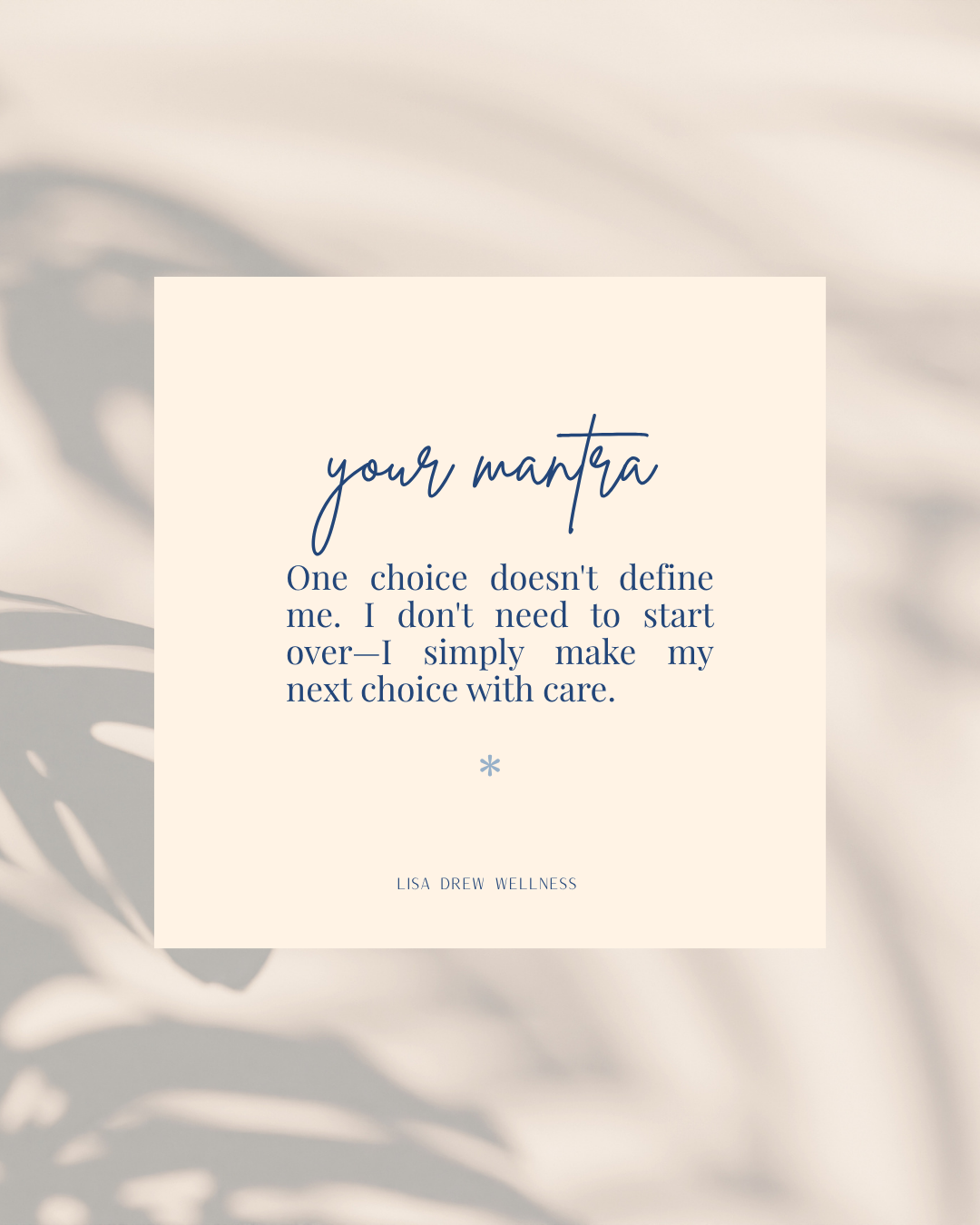
One choice doesn't define me. I don't need to start over—I simply make my next choice with care.
And if today's next choice happens to include a cookie?
Eat the cookie.
Enjoy it.
Then keep living your life.
Because that cookie never had as much power as diet culture convinced you it did.